In handwriting analysis, there exists two sharply differing schools of thought: that of graphology and that which most modern forensic scientists ascribe to, which deems graphology to be scientifically invalid. Graphology is handwriting analysis used to assess personality, dating back to Confucius, who stated, "Beware of the man whose writing sways like a reed in the wind." The first detailed work on graphology was in 1622, when in his A Method to Recognize the Nature and Quality of a Writer from His Letters, Italian physician Camillo Baldi said, basically, that every person's handwriting is entirely unique to themselves and cannot be perfectly imitated, which is still handwriting analysis' guiding principle today. In the next three centuries, investigators attempted to solidify the validity of graphology, linking it to Gestalt psychology, believing that, as handwriting stems from the brain, reveals the writers' mentality. They claimed that everything from pressure, speed, interruptions, and angle of letters could be measured to establish a psychological profile of the writer.Modern forensic scientists, for the most part, though, believe graphology to be mere pseudoscience. It has, however, been used in tandem with other techniques, such as the case of the "Mad Bomber" of New York City. Much more commonly, though, handwriting analysis is used either to authenticate documents or link a suspect's handwriting with that on a ransom note, for example.
 |
| Camillo Baldi's work |
2. 12 Handwriting Characteristics:
1. Line Quality: See if the lines are smooth and flowing or shaky and wavering. This can also be used to determine speed with which the document was written.
2. Spacing of Words and Letters: Check if the spacing between letters and words is consistent.
3. Ratio of the Relative Height, Width, and Size of Letters
4. Pen Lifts and Separations: Is there a pause in writing to form new letters and words?
5. Connecting Strokes: Look if capitals are connected to lowercase letters.
6. Beginning and Ending Strokes: Are they straight, curled, long, short, an upstroke, or a downstroke?
7. Unusual Letter Formation: Are there any backwards letters or tails?
8. Shading or Pen Pressure: Is pressure on down or upstrokes?
9. Slant: Does it slant left, right, up, or down? Is it consistent?
10. Baseline Habits: Is the writing above, on, or below the line?
11. Flourishes and Embellishments
12. Diacritic Placement: How are the t's crossed or i's and j's dotted? Are the dots to the left or right of the letter?
3. Handwriting Analysis Template:
The person doing the freehand forgery of my handwriting wrote much smoother and slower than mine, particularly with the cursive. The space between the forgery's words was also inconsistent and tilted on the line, which both differ from my own writing. On the other hand, with tracing the forgery was nearly identical. They both seem to have been written quickly and slanted to the right for the print, while the cursive both appeared shaky and the cursive "m" had a bump in the right side. I believe that the tracing was much easier, but since two pieces shouldn't look exactly the same, it may raise suspicions if the forgery is too perfect.

4. Reflection on Check Forgery Activity:
To start this activity off, we each filled out a fake check using a false name; these checks were then torn into many pieces and exchanged with another group's checks. We were also given the people in the other group's Handwriting Analysis Templates for comparison and identification of who wrote which check. The first part was, of course, to re-assemble to ripped-apart checks. We then simply compared them to their Handwriting Analysis Templates; everyone in my group properly identified which check matched up with who. The characteristics that were most distinguishing in the check I analyzed were the slight slant of letters to the right, the light pressure, and that all of the letters and words were very close together.
5. Famous Case Using Handwriting Analysis:
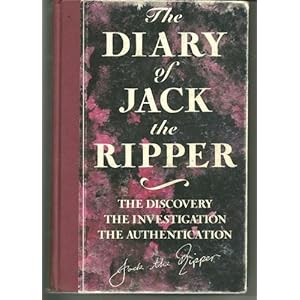
In 1992, Michael Barrett, an unemployed man in Liverpool came forth with a diary supposedly written by Jack the Ripper that he claimed was given to him by friend Tony Devereux in a pub. When this was questioned, the story changed to that Barrett's wife, Ann, had had it in her family for as long as she could remember. Even through this, it was published as The Diary of Jack the Ripper in 1993. Tests were performed on the diary's ink but with no definitive conclusions. Then, document expert Kenneth W. Rendell examined the diary and found that the writing was not Victorian in style and saw many handwriting inconsistencies. This, along with some further testing, caused Michael Barrett to confess that he authored the documents while his wife wrote everything out.

Great details and descriptions but remember to create a biblography and also site pictures.
ReplyDeleteVERY nice information.Very descriptive and I love the famous case you chose!
ReplyDeleteI too like the case. I personally never heard of it, though it's vry interesting.
ReplyDeleteNice Post Thanks For Sharing
ReplyDeleteHandwriting expert
Forensic Expert
Nice Post you write Thanks For Sharing with us.
ReplyDeleteHandwriting expert