One of the first scientific reports involving trichology, which is the study of hair, was published in France in 1857. Forensic hair/fiber analysis then developed into an established science in the early 1900s. In 1931, Scottish forensic scientist John Glaister published his Hairs of Mammalia from the Medico-legal Aspect, and then in 1937 his A Study of Hairs and Wools Belonging to the Mammalian Group of Animals, Including a Special Study of Human Hair, which, affirmed the accuracy of hair/fiber analysis and made him a world-renowned resource in the field. Then, in 1977, John Hicks' Microscopy of Hairs: A Practical Guide and Manual detailed the process of analyzing hair/fiber evidence for forensic examiners.
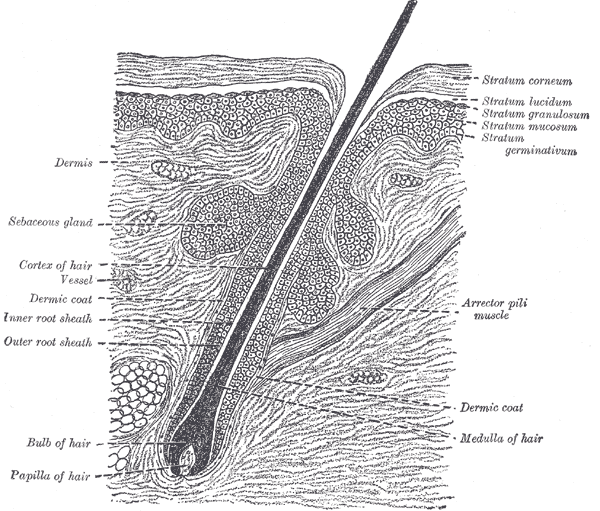
2. Parts of a Complete Hair:
3. Major Types of Fibers:
Cashmere: This is a type of animal fiber made from the cashmere goat in the goats' molting season when they naturally shed. Its fine, soft fibers give excellent insulation without being bulky, and it comes naturally in shades of grey, brown, and white. The fibers are also very adaptable and easily spun into yarn.
 |
| Cashmere Goat |
 |
| Cashmere Fiber |
 |
| Silk Fiber |
 |
| Linen Fiber |
 |
| Ramie Fiber |
 |
| Acrylic Fiber |
4. Hair/Fiber Collection Techniques:
Combs, tweezers, or a filtered vacuum device to collect any evidence found at the crime scene. In the case of rape with a live victim, the CSI unit accompanies the victim to a hospital for medical examination to obtain hair or fiber found in the examination. During an autopsy, the pathologist will also scrape under the victim's fingernails to find any hair or fiber remaining there; this can indicate whether there was a violent struggle where the victim pulled at the assailant's hair.
5. Typical Hair/Fiber Analysis:
Forensic scientists typically use a Scanning Electron Microscope to determine the species, race, and somatic origin of the hair. They may then test for DNA on the hair's follicular tag and test for drugs and environmental toxins. Hair absorbs metabolized drugs that are sent into the hair follicle through the blood stream. This can be used to detect many recreational and therapeutic drugs, such as cocaine, heroin, benzodiazepines, and amphetamines. Forensic toxicologist may also search for toxic metals in hair to explain poor psychological or physical health. Nuclear and mitochondrial DNA can be extracted from hair roots to help identify the victim or suspect since this DNA comes from one's parents, though mitochondrial DNA only comes from the mother.
 | ||
| Scanning Electron Microscope |


6. Reliability of Hair/Fiber Data:
While data from hair/fiber analysis can be very informative, results are rarely seen as conclusive. This is particularly the case with fiber. Though DNA extracted from hair is accurate, fiber must be matched up with a suspect by means of statistical elimination.
7. Notable/Famous Case Where Hair/Fiber Were Used:
Hair analysis played a crucial role in the case of James Driskell who was wrongfully charged with the 1991 murder of Perry Harder in Winnipeg, Canada. Harder had last been seen outside of his house in a pick-up truck. Three months after his disappearance, Harder's body was found in a shallow grave and had been shot at least once. Harder and Driskell had been charged previously with possessing stolen goods; it was thought that Driskell would have murdered Harder in order to prevent Harder from testifying against him. The only evidence obtained against Driskell was the presence of three hairs in his van that supposedly belonged to Harder. DNA testing later proved this to be entirely false, which made the procedure of visual hair analysis obsolete. Driskell had been freed since 2003 after his serving for twelve years in Stony Mountain Penitentiary for first-degree murder. His lawyers were James Lockyer and Alan Libman, both defense lawyers in the Assocation in Defense of the Wrongly Convicted.


Many details and great pictures to go along with them.
ReplyDeleteGreat pictures! Where'd you find them? Great ratio of pictures to text!
ReplyDeleteWow a lot of info, that's good but can also be bad, beware and seuch
ReplyDelete